.

Friday, January 29, 2016

Painting the Hull

0

This has been on the list for…. a year?
We always put off doing any exterior work because with all our attention focused on the interior, who cares what the outside looks like!?!  Well, with a splash date in the near future it's turned into a now or never type of project.  We decided to paint just the hull for now.  Once we are in the water and have more time, we will tackle the decks and pilot house, too.

On rickety scaffolding!

I did a little sanding and found that the Bondo used to fair the hull had pulled away from the aluminum just a little because of corrosion. 

I continued sanding until I had "white metal" showing and then primed it with zinc chromate to seal the metal.  


After all the sanding, fairing, taping, wiping, and dusting I was ready to get a coat of paint on her!  We're going with a very light gray for the hull and a color called "tropical splash" for her stripe.  One of the yard guys put it well when he complimented our choice of colors.   "She doesn't look so serious anymore"
 
Posted by Picasa

Read more

Lapping & Lubing

0


Boat Lesson:  Thru-hulls are holes in the hull of your boat - some are above water and some are below water.  Why do you want holes in the hull of your boat?  Well, the connect your sink drain, your toilet, your blige pumps, etc to the ourside world.   If the hole is below water it is standard practtice to have a seacock mounted on the thru-hull.  A seacock is a simple on/off valve. The valve should easily turn off in the case of a hose rupture so that you don't sink your boat.  

 
Posted by Picasa

Read more

Thursday, January 28, 2016

The Beginning of a Galley

0

I'm having a hard time picturing what the end result galley will look like, but I've got to start somewhere so we decided to create a step for the fridge and chest freezer so that we can secure them for the summer.  Sasha is installing fresh water outlets behind where the fridge will sit.

My fridge on it's shelf!  I'll post pics of the freezer soon.
 
Posted by Picasa

Read more

Zincs + Propeller Install

0

Zinc is a less noble metal than aluminum or steel.  This is important because electrical currents and salt try continuously to eat away at our boat, but these little bits of zinc we have attached to the hull, rudder, and propeller shaft will all dissolve and sacrifice themselves to save our boat.  These zincs are usually replaced each time a boat is hauled.

Sasha even went out a bought a huge wrench to tighten the nuts.  

Now he's working the nuts into place.  There are two nuts that lock onto one another to be sure we don't spin off the propeller. 

Good and tight!
Posted by Picasa

Read more

25 YEARS LATER ANOTHER DRAGONFLY 25

0


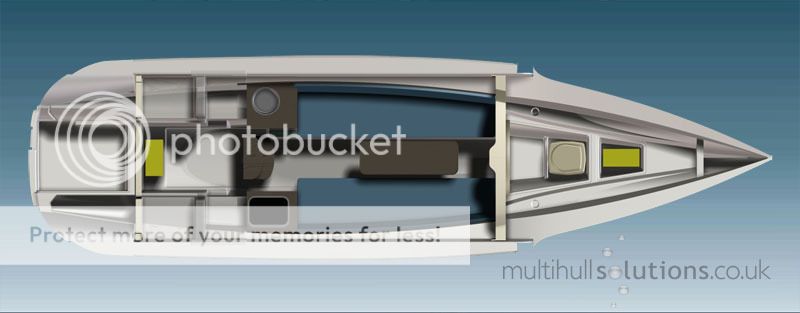
The 25 was the first Dragonfly so a new 25 means something, this was supposed to be a very special boat and it is in fact a more modern design but I think they could have gone further. The floaters are beautiful with a lot of buoyancy (160%) but the central hull could be nicer (in what regards that the new Corsair daysailer seems nicer to me).
A very nice boat with an interior suitable for short range coastal cruising and certainly a good racer, a very fast sailing boat for sure. They have already sold 5 boats that should cost about 69 000 euros (without VAT) with a 5hp outboard and sails.
They say about the boat:

"Both versions will have the same offcenter Kickup centerboard in the mainhull, to create more space inside the boat and the centerboard casing is hidden inside and under the port sofa seat in the center cabin. Both rudder systems will also be able to kickup.

The standardboat will have a 10.50 m Aluminium rotating mast and the Sport version will have a 11.80 m rotating Carbon mast.
The floatdesign is in a total new design and construction, still asymmetric shapes to get better hydrodynamic lift and also to get more buoyancy in the right place. The floats are in new and better hydrodynamic design, so the floats will be more fun to push harder and will have better waterflow. 
The floats will have 160% volume, and will be the highest volume floats we have yet ever made in our designs. This means the boat can actually easy fly the centerhull, not that this is the purpose, as the boat will be fastest when the centerhull is just airborne, but it will give more safety as also the floats are actually 30 cm longer forward of the centerhull to give more diagonal safety and stability."

Read more

Oven Hood

0

Lots of people ask isn't your galley going to be super hot with a big oven in it?  Here is our attempt at cooling it down. 

Sasha is holding the hood in place so I can quickly snap a pic.  He looks calm, but this custom built hood is pretty heavy.  We measured our space and sent a drawing to a metal shop on Tortola.  Two weeks later we had a stainless steel hood that fits into place perfectly.  


Once we marked and drilled hole to bolt it hood in place we were ready to roll.  

Read more

MINI TRANSAT - THE FIRST LEG IS FINISHED

0

But of course the first leg means nothing and it is to win the race that counts. Even so the best are already on the head of the race. On Proto the first to arrive to the Canary Islands was Davy Beudart, the 2nd Axel Trehin and the 3rd Frederic Denis. Here some movies with them:
In what regards boat design nothing surprising, the bath-tube bow and a David Raison boat continues to win and with a considerable advantage over the 2nd that is an older Lombard design (2008). The 3rd is also a Lombard design, but a more recent one (2011). In what regards the serie boats (production boats) the battle for first has been a lot more hard, maybe because there are a lot more racers on this category. Ian Lipinsky came first followed closely by Tanguy le Turquais and Charly Fernbach. Some movies with them and their boats: Regarding boat design we also have three different designs on the first 3 places but in this case they are all new designs: The first is a Bertrand design, built by the NA himself, the 2nd a Lombard design built by Argo and the third a Pogo 3. Those boats are really amazing, relatively cheap and with a performance not very far from the protos, that are all carbon boats with canting keels. The difference between the first proto and the first serie was of about 18 hours but if we consider the 2nd the difference was only 10 hours and only 8 protos (in 26) managed to do better than the first serie mini. To really see that huge difference between the two boats, in what regards high tech materials and building, let's have a look at a Pogo 3 and Davy Beudart proto:
For following the race (in English, French or Spanish), with a real time map click here: http://www.minitransat-ilesdeguadeloupe.fr/. It starts again in some days (not all the boats have finished), now towards Guadalupe.

Read more

 
Powered by Blogger