.

Monday, February 1, 2016

Design 688 - River Steamer

0


This vessel was designed with sufficient power and maneuverability to negotiate the rapids of the Upper Yangtze River in China. Dry cargo was carried on the main deck and loaded through side ports. Hull tanks were installed to carry 615 tons of Tung Oil.

Passenger Capacity
1st Class - 24
2nd Class - 36
3rd Class - 201

Power Plant
Steam - Twin screw - Twin uniflow engines - Two water tube boilers
2,400 shaft horsepower for 15 knots

Principal Characteristics
LOA 253'-0"
Beam 48'-0"
Draft 8'-0" (light ship) 12'-0" (full load)

Read more

WHAT RUDDER IS BEST FOR CRUISING: SKEG RUDDERS? SINGLE SPADE RUDDER? TWIN SPADE RUDDER?

0


That's a subject that has been recently discussed extensively on internet forums even if the answer to that question has been given by the most prominent NAs on the design of most  recent cruising boats: Almost all feature a twin rudder set up. To the more distracted, let me point out that a two rudder set up has nothing to do with a twin wheel set up. A twin wheel set up can drive a single rudder or a twin, as a single wheel can drive a twin rudder system. That's true that a twin wheel setup is today the norm but some drive a single rudder and the reason for its almost universal use on cruising and also most racing boats has nothing to do with a single or twin rudder setup.
So, let's focus on the rudders: It seems obvious that the more protected rudder is the one that comes on the continuation of a full keel. But there is an efficiency problem: the rudder to work well has to be in the way of the water flux (not to mention the efficiency of a full keel), the further away from the keel the better and in what regards that, it cannot be a worse situation that a rudder immediately aft a full keel.

The next step, following the search of a more efficient and better sailboat, in what regards rudder, it was to separate the rudder from the keel, using modified fin or fin keels. Almost all the first rudders of that era used a skeg, most of the times an integral one that protected all the length of the rudder. That improved the rudder efficiency but also revealed some problems regarding the use of skegs: They found out that a skeg could not be strong, otherwise the skeg would resist to a strong impact or grounding, but the force transmitted to the hull, multiplied by the long arm due to the depth of the rudder, would risk to break the hull at the insertion point.

After finding out that problem, the skegs become thinner and as the rudders, sacrificial, face to the hull integrity.One more step brought boat design to modern spade rudders, rudders  designed for max efficiency, away from the keel and designed, as the skegs, with a sacrificial function: They should be strong enough to sustain all the abuse strong sea conditions could have on them, resist small shocks but face big shocks, they should break or bend in in a way that protect hull integrity. Not an easy compromise designing a rudder that responds to these two apparently opposed constraints.

Better keels, better hulls (with the beam more brought aft) and lighter sailboats give cruising boats a better sailing performance. The rudders have to be designed not just to respond to a slower and more sluggish sailing, but to boats that have an increasingly better performance and that, in what regards rudder design translated in more efficient rudders, auto aligned, balanced and more deep.

Deep rudders, some almost the depth of the keel, are more vulnerable, not only due to the bigger efforts that a deeper rudder generates, but are also more exposed to breakage due to groundings or eventual shocks with submerged objects. Besides it was discovered that in beamier designs with the beam brought aft, due to the strongly asymmetrically wet surface when the boat is heeled, the best position to a rudder is not at the center of the hull, but at the center of the wet surface (while the boat is heeled) and that means on the side and therefore a rudder on a twin rudder setup, that would respond to this demand, could be much smaller, much less deep and have less efforts than a single rudder positioned at the center of the hull.

Rob Humphreys describes here the benefits observed through a tank testing that was performed on a Oyster 885 model and that convinced Oyster management regarding the benefits of using twin rudders on their line of yachts:

"David’s naval architecture back -ground (David Tydeman is the CEO of Oyster Group) quickly helped me persuade him that twin rudders were the way to go! It was clear that this was going to be a bit of a sea-change for Oyster and I was pleased that David was keen to push this onwards and also to support this breakthrough with a decent budget for tank testing. We both felt it would be helpful to have fairly tangible reference information for those owners trying to understand the shift from a skeg-rudder to the twin rudder form for this exciting new model.

In fact our testing session set out to do more than just this because we also used the opportunity to let the spade rudder have its say, just for some form of completeness. We have often been asked why Oyster has tended to steer clear of spade rudders and the answer has more to do with potential vulnerability than any disrespect for its potential qualities. As any Oyster owner knows a blue-water cruising yacht has to be accomplished in a number of different ways, and one of the lower profile requirements has to be an ability to slide backwards against a Mediterranean harbour wall without necessarily endangering the steering gear. ..

In our tank testing we were focusing our attention on a fully-pressed up set of sailing conditions, with the boat heeled over to twenty degrees and sailing at nine knots, with a variety of leeway angles and load conditions. .. We tested a lot of other things as well but the rudder testing part was most interesting and was totally supportive of all that we had learnt to be true in the field. ... For example, with the twin rudders set to just two degrees to the flow the spade rudder needed to be at over six for an equivalent moment, and the skeg-hung rudder at eight – all for the same yaw moment.Put another way, the leeward twin rudder provided 4 times as much force than a skeg rudder!..

From our perspective twin rudders represent a huge benefit and an Oyster owner will really appreciate it too as soon as he has the wheel at his finger-tips. But what’s also interesting is that the system fares a lot better in terms of potential reliability, especially against the spade rudder. The blades are significantly smaller and more lightly loaded, and the span is considerably shorter, making it almost impossible to damage the steering gear when reversing into a quay. And of course, with two rudders rather than one there is an obvious increase in the level of redundancy. Unlike some twin-rudder installations, the arrangement we have for Oyster means that even assuming the worst-case loss of one rudder it would be possible to still sail the boat on the compromised tack, albeit with reduced canvas."

This pretty much says it almost all regarding why a twin rudder is more adequate to a cruising boat and does not tell the full story. There are certain things you can't measure on a tank test and one of them is the feel you have on the boat and the easiness to control it. In what regards that ,sailors that experienced twin rudder configurations, reported in almost in all cases a superior easiness to control the boat, specially downwind, and that makes sense if we take into account the superior directional stability that the two rudders on the sides will provide compared with a single one at the middle.

So, the single spade rudder is as dead as the skeg rudder? Not quite. I continue to see designs of racing boats and of top cruiser racers, designed with CFD and VPP extensive use, that continue to use a deep very narrow spade rudder. Rating formulas can have to do with that but I am more inclined to think that for absolute maximum performance, less drag and maximum rudder sensibility, those rudders offer advantages but in all the cases we are talking about boats designed to offer maximum performance, with a crew and that demand a very exigent and controlled sailing. Solo racers have for many years adopted twin rudders as the better solution and that has probably not to do with absolute performance but with the requirement such boats have to be easily controllable, since they are sailed solo and many times on autopilot.

Read more

MALANGO 888 NEW TEST AND NEW VIDEOS WITH THE MOJITO 888.

0

I had posted recently about the Mojito 888:
http://interestingsailboats.blogspot.pt/2014/10/mojito-888-voile-magazine-boat-of-year.html
http://interestingsailboats.blogspot.pt/2014/10/on-water-rm-890-versus-mojitomalango.html

After having won the Voile magazine boat of the year contest the interest in the Mojito went up sharply and the boat has been tested by the other main French sailing magazines (Voile and Voiliers and Bateaux) and looking how the boat sailed on both occasions I bet we will continue to hear nice things about the boat. First a video with the boat being tested by Bateaux (very light wind) and then 3 others from the Voile and Voiliers test showing the boat sailing in medium wind in several points of sail:


The interest on the Mojito seems to make revive the interest on the Malango 888, basically the same boat with a different cabin and we have a new test, surprisingly by a British Magazine. It seems that on the last years finally the British, that have a more conservative approach regarding cruising boats, seem to be interested on the light fast and seaworthy cruising boats derived from the Ocean solo racer's hull concept.

The test is from Sailing Today. I did not like other test made by the magazine but this one is made by a new tester and what they say about the boat corresponds to the information I got about it, reading other test sails. It seems a good test to me. They say about the boat:

"The boats are drawn by Breton naval architect Pierre Rolland, who favours a purposeful plumb bow, hard chines and a wide stern. The racing pedigree is immediately obvious, and in fact, the design is derived from a singlehanded mini Transat racer. And yet, the boat’s raison d’etre is to provide a sporty sail for cruising sailors...It’s all about the pleasure of sailing,..

The techniques used to build the Malango are decidedly modern. Vacuum infusion spreads the resin evenly through the layers of fibreglass and honecomb-cell felt for the minimum weight.

..it’s worth noting a key feature of the boat, and one of its chief concessions to cruising: the transom includes a deep 2.1m recess which perfectly accommodates a 2.4m dinghy. Being low to the water, the cut out for this dinghy garage doesn’t intrude on the stern cabin, but forms part of the structure of the stern berth.

.. we scoot upwind at an easy 7 knots, heading some 40° off a true wind of 13 knots. Reaching up and down off the beach at nearby Port-la-Forêt, dodging waterskiers, we settle into a 7.8 knot lope and we hit 9 knots surfing back downwind flying the 75m2 symmetrical spinnaker. Although this is a sporty boat, she’s very well behaved, reluctant to broach (you can really feel the chine digging in aft) and therefore easily handled by one."

The genoa is on a furler and the sheeting point is controlled not by a traveller (keeping the side decks clear), but by the increasingly fashionable light eye on a Dyneema strop – a barber-hauler which can be pulled closer to the centreline or slacked off.

Verdict: At a touch under 30ft, the Malango 8.88 ..she has the heart, soul and the capabilities of a larger cruiser.... Her lithe, sporty lines and muscular performance mark her out from the many gaffer-likes produced in Britain – we simply don’t have an equivalent to the Malango that I’m aware of. She’s fast, but stable and easy to handle, making her good for family cruising or outings with friends. She’s been designed to a firm cruising brief, with the ability to dry out easily on sand – perfect for her native Brittany and with a few modifications – renewables, watermaker, extra electronics – she’d make a capable, but cosy, bluewater cruiser. That’s why she’s able to make a European Category A rating and indeed one of the 11 boats built so far has crossed the Atlantic to the Caribbean".
http://www.sailingtoday.co.uk/boats/big-boat-review/melango-88-8-review-test/

They also have made a video of the test:

Read more

Design 2571 - Preliminary Design of a Hinckley 54' Sloop

0


I don't recall the logic in designating this boat a 54'er, which is her length on deck, versus her overall length of 57' but there must have been some marketing guru involved. This preliminary design was prepared for the Hinckley Company of Maine but never came to fruition. The year was 1990.

Here is the general arrangement plan.


Principal Dimensions
LOA 57'-3"
LWL 42'-9"
Beam 15'-6"
Draft 5'-11" (board up) 11'-2" (board down)
Displacement 44,966 lbs
Ballast 17,000 lbs
Sail Area 1,544 sq ft

Read more

Nice Image - Dorade

0

Courtesy of Billy Black

Here's a great image we received of Dorade, design #7, sailing off of Rose Island near Newport, Rhode Island. Thanks Billy.

Read more

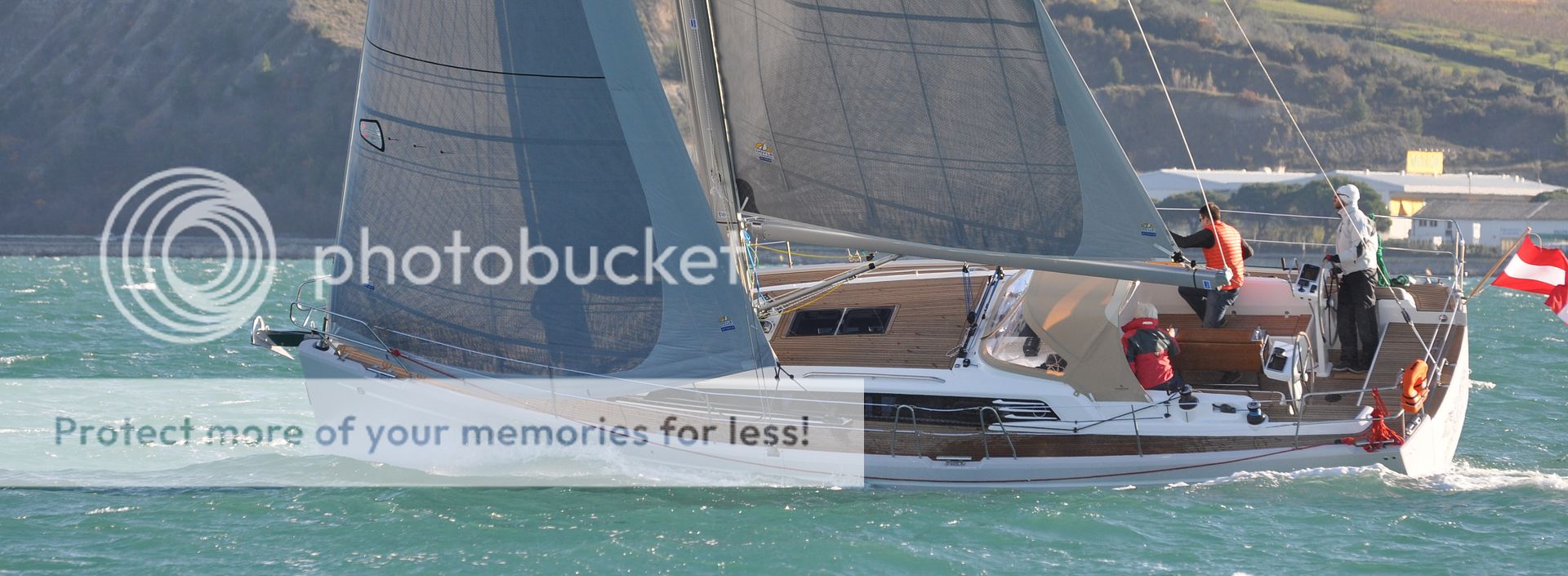
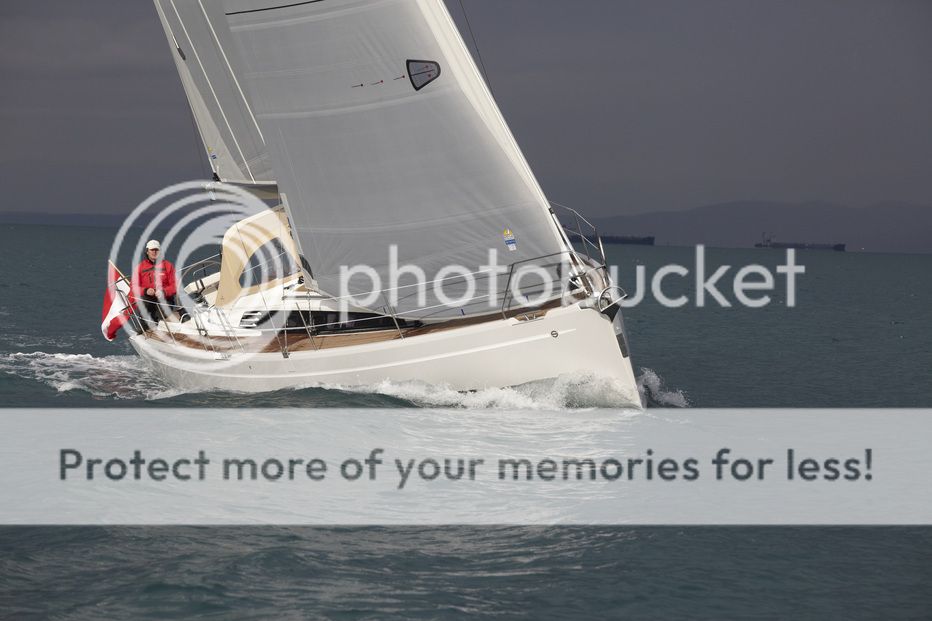
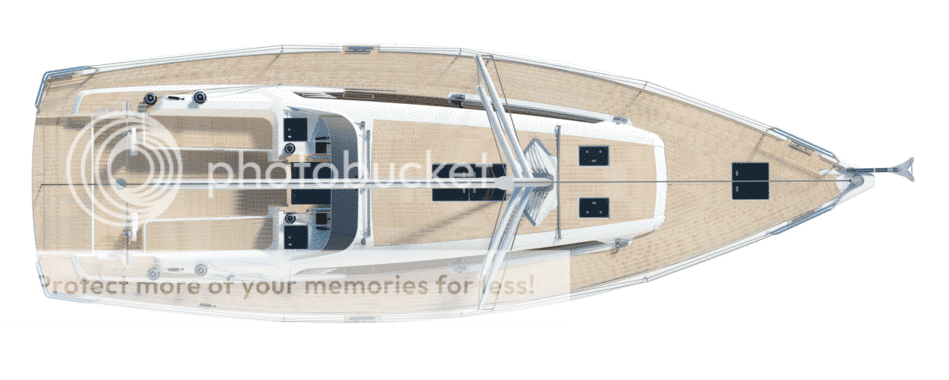
SUNBEAM 40.1 A GREAT CRUISER

0


This is a post that I have wanted to make here for a long time about a very interesting boat that will probably (unfortunately) be a commercial failure. I had already posted about it when it was on the project stage and it seemed already a very nice one.
http://interestingsailboats.blogspot.pt/2014/06/sunbeam-401.html
Now that it is on the water and I have seen it at Dusselforf a follow up makes all the sense. 

The Sundbeam 40.1 is a lovely medium to light weight boat and even if they prefer to evidence its “sportiveness” it is not a performance sailboat but one that one can put on the same category as the Halberg-Rassy 412, a more sportive one but not a cruiser-racer. The boat is not as expensive as the Halberg Rassy 412, it is a bit smaller and considerably less heavy being a much slimmer and elegant boat. 

While the Halberg Rassy makes more concessions regarding interior volume the Sunbeam makes a lot less as it makes less in what regards effective sailing and beauty. Sunbeam is an Austrian brand, not very well known but that has been making quality boats for more than 50 years. On the past the boats were very well built but in many cases the looks were very similar to Bavarias. That was in the past since now they have a line of beautiful, elegant well built boats that sail very well, designed by J&J curiously the one that designed the pre-Farr Bavarias.

I have in the past visited several Sunbeam and even sailed side by side (at least for some seconds ;-) with some. I was always impressed with the built quality and finish but this time in Dusseldorf, I was not only impressed with that but with the quality of the design at a very good price. 

Comparing the HR 412 with the Sunbeam 40.1 will give some clues about the differences. The HR has a bigger LOA ( 12.61m to 11.99) the HR has more beam (4.11m to 3.99) both featuring modern transoms with the beam pulled back. The Sunbeam has a more effective keel with about the same standard depth (1.99m to 2.00). 

Regarding stability the Sunbeam balances the HR bigger form stability with a similar ballast ratio (0.36 to 0.35) but a much more effective keel (for the same draft), that means that the HR will sail with slightly less heel but that the Sunbeam will have a better final stability. 

 The HR weights 11.1T while the Sunbeam only 8.5T and the superior slightly bigger sail area of the HR (90m2 to 87.5m2) will not prevent the much lighter Sunbeam (and less beamier boat) to be a faster boat, specially upwind (and the HR is already a fast boat for a medium weight boat). 

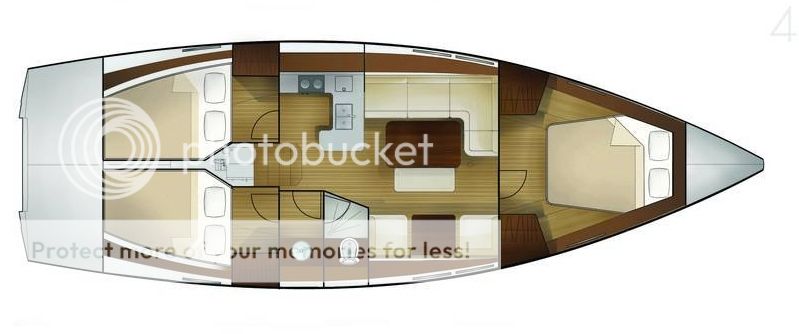
The interior is a very nice one, slightly on the conservative side but cosy and the quality is evident. The storage is adequate specially on the two cabin version having the boat a very useful fender locker aft the anchor locker.


Several magazines have tested the boat and all the reviews were very positive, especially in what regards sailing. A great boat that I would say will miss a market since the ones that are after that type of boat want more interior space and will compromise a lot for that and in what regards performance cruisers, well it is not one, not comparable with true ones like the Arcona 410 just to speak of one with similar quality. At about 250 000 euros (without VAT) it is an interesting boat at an interesting price.


Maybe it is just your type of boat, not too sporty, not too fat, not too slow (meaning faster than most new cruisers) and a beautiful one with a great cruising interior.

Read more

Preliminary Design - 49' Motoryacht

0


This preliminary design was prepared for Walsteds Bådeværft of Svendborg, Denmark. My suspicion is that this was prepared for a client of theirs. They year was 1994.

Principal Dimensions
LOA 49'-2"
LWL 40'-0"
Beam 14'-9"
Draft 4'-0"
Displacement 39,800 lbs (1/2 load)
Power 2 x 266 hp each

Read more

 
Powered by Blogger